
SikkensFoundation
HISTORY — The Sikkens paint and varnish factory, which started in 1792 as a varnish manufacturer in Groningen and joined the chemical concern KZK (later Akzo) in 1962, is one of a series of Dutch companies which have built up a special relationship with artists, designers and architects. A number of illustrious early examples of this include the Leerdam glass factories, the fashion and department store Metz & Co., and the Van Nelle factories. No matter how different these companies may be in terms of size, production and composition, they have one thing in common: an inspired and progressive management. The directors are aware of the influence of design (of their product) on society and on the quality of the environment. The management have a sharp vision of their role as carriers of culture, a position which extends beyond the immediate interests of the company. All these qualities could be attributed to the chemist August M. Mees who entered the employment of Sikkens in 1924. The necessary innovations and extensions took place in the paint factory under his management. In 1939 the company moved to a newly built factory in Sassenheim. A number of mergers followed in 1958, resulting in the Sikkens Group, which continued as part of the Coatings Division of Akzo from 1969. After the war, Mees expressly related his company policy to the new leap forward in art and culture. Sikkens sold paint, paint is color and color was up and coming after the grey years of the war and the post-war period. A new generation of artists and architects based themselves on the heritage of De Stijl, with color heroes such as Rietveld, Van Doesburg and Van der Leck. Color creates the space, and this principle was the starting point of various artists and architects in the 1950s and 1960s. Sikkens first exhibition on the subject of color in the home, made in cooperation with the Goed Wonen (Good Living) Foundation in 1957 was very well received. Sikkens decided to have a range of colors composed by artists who were affiliated to the Liga Nieuw Beelden. Color was an important medium in the Liga’s aim to achieve a synthesis of architecture and the visual arts. The creation of the range of colors was widely publicized with the “Color” exhibition in the Stedelijk Museum. The director, Mees, announced the foundation of the Sikkens Prize on this occasion and it was inaugurated in 1959. The initiative by Mees was, on the one hand, the result of his interest in the visual arts, and on the other hand, his position in a company in which color is a leading factor in the manufacture of the products. The prize was intended as a mark of appreciation of those artists, architects and designers who had created a work in which a synthesis of color and space was achieved. In the first few years the attention focused on the function of color, the effect of the environment and human behavior, and the methodical application of color. Color, and therefore the Sikkens Prize, had an educational value. Back to home
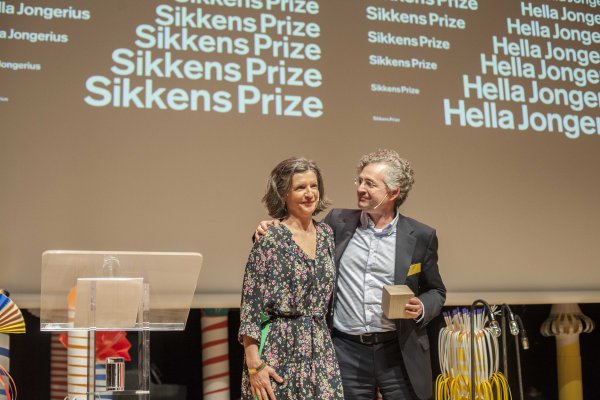
In the 1960s, the Sikkens Foundation changed course under the influence of the social climate. The whole Sikkens Prize Foundation was convinced that the Sikkens Prize should be socially relevant. In the early 1970s, the Sikkens Prize combined with the Talens Prize. Up to then the International Talens prize had been awarded twice: to Willem de Kooning (1968) and Richard Hamilton (1970). In 1971, the two prizes were amalgamated. The name of the Sikkens Prize was maintained and the emphasis shifted from reward to stimulation. The aim was formulated as follows: “To stimulate the social, cultural and scientific developments in society in which color plays a specific role as a medium”. It is the formulation which still applies today. On 18 July 1972, the Sikkens Prize Foundation was officially established by the board of directors of Akzo Coatings N.V. in Amsterdam. This meant that the reasonably informal relationship to the business acquired a clear status with formal competences and a financial basis. The formula which had applied up to that time was extended and the attention of the board of the Sikkens Foundation focused more on color as a universal phenomenon. In the following years, the Mondrian lecture became established, and the Award gained a physical identity in the form of a glass prism designed by Carel Weeber. In the 1980s the foundation initiated even more projects than in the past. On 12 November 1987, the Sikkens Prize Foundation became the Sikkens Foundation with a change in the articles of association which gave the board more operational room for maneuver. In the past decade, the Sikkens Foundation has developed to become a leading institute for sponsoring private culture in the Netherlands. The search for the use of color in society was carried out by the foundation with passion in the past and it will continue to take up this challenge in the future as well. The fact that a concern such as AkzoNobel is behind this is more significant than merely providing the financial basis or the success of a marketing concept. It is a modern patron of the arts which restores and strengthens links between culture, society and industry. Download text as pdf